
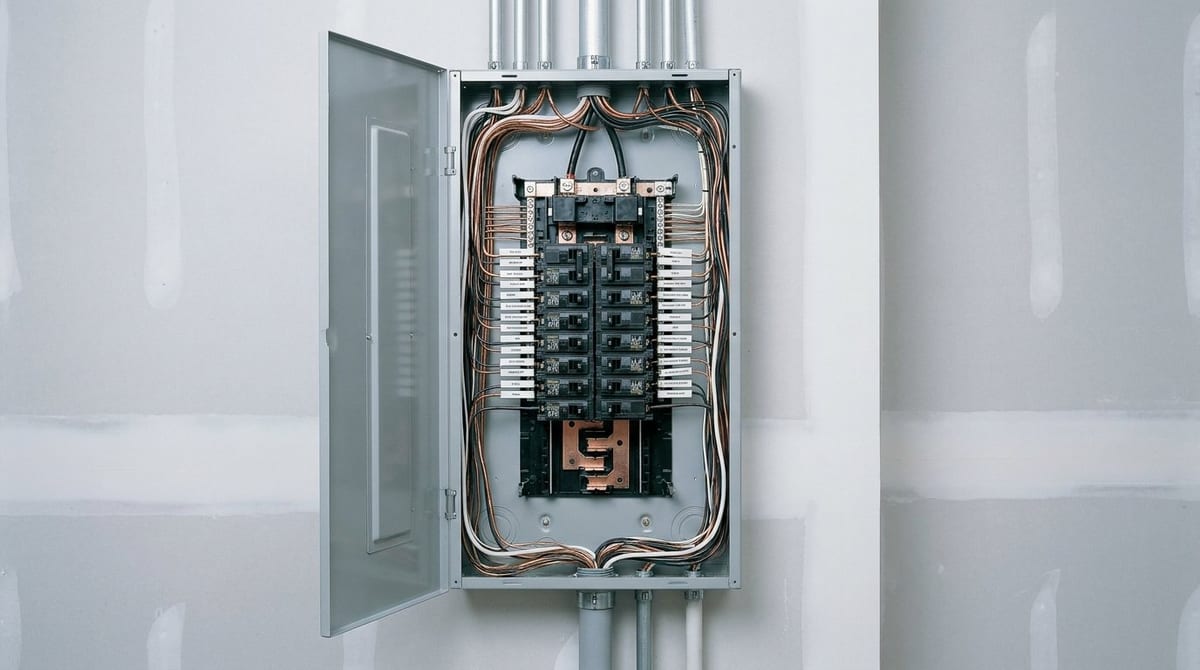
How much does it cost to rewire a house?
The factors that move the price — and why access matters most.
By The T.A.P. Team · January 2024 · 5 min read
The cost to rewire a house depends on more than square footage — the biggest factor is access. Rewiring an open-wall remodel, or a home with an accessible attic and crawlspace, is far cheaper than fishing new wire through the finished walls of a slab-on-grade house. Other drivers are the home's size, the number of circuits and outlets, the existing wiring type, and whether the job includes a panel upgrade. Here's what moves the number and how to get an accurate quote.
- Home size (square footage, # of circuits)
- Access — open walls vs. finished (the biggest factor)
- Slab vs. crawlspace/attic access
- Wiring type being replaced (aluminum, knob-and-tube)
- Whether a panel upgrade is included
Why access is the biggest factor
Most of a rewire's cost is labor, and labor is driven by how hard it is to reach the wiring. Open walls during a remodel, or a home with a walkable attic and a crawlspace, make the work far faster than a single-story slab house where every wire has to be fished through finished drywall. This is why timing a rewire with a remodel — when the walls are already open — saves the most.
Size and scope
More square footage, more circuits, and more outlets and fixtures all add to the total. A whole-home rewire costs more than replacing a few problem circuits. Bringing everything up to code — adding grounding, GFCIs, and AFCIs — is part of a proper rewire and factors in too.
Panel and service upgrade
A rewire is often paired with a panel or service upgrade, especially in older homes with 100-amp service or a fuse box. That's a related but separate cost — worth bundling, since the electrician is already there and the whole system is being modernized.
Getting an accurate quote
Because access varies so much house to house, the only reliable price comes from an on-site assessment where an electrician walks the home, checks the wiring type and access, and scopes the circuits. Be wary of sight-unseen numbers. See our electrical cost page and our electrical services.
| Cost driver | Effect on price |
|---|---|
| Wall access | Open walls cheap · finished walls costly |
| Home size | More sq ft / circuits = more |
| Foundation | Crawlspace/attic easier than slab |
| Wiring type | Aluminum / knob-and-tube adds work |
| Panel upgrade | Common add-on cost |
| Whole vs partial | Targeted rewire costs less |
Rewiring cost hinges on access, which no one can judge without seeing your home — so insist on an on-site assessment, not a phone estimate. And if a remodel is anywhere in your plans, do the rewire then: open walls slash the labor that drives most of the cost. A measured, written quote from an electrician who has walked the job is how you compare fairly.
Rewiring costs in DFW homes
North Texas has both slab-on-grade homes (harder access) and older pier-and-beam homes (easier crawlspace access), so rewiring costs vary widely across Plano, Richardson, and Garland. We give on-site, written quotes. See our electrical team.
The short version
- Rewiring cost depends most on access — open walls are far cheaper than finished ones.
- A remodel is the cheapest time to rewire, because the walls are already open.
- Home size, circuit count, and wiring type all move the price.
- Slab homes are harder to access than crawlspace/attic homes.
- A rewire is often bundled with a panel or service upgrade.
- Get an on-site, written quote — access varies too much for a phone estimate.
Rewiring cost — frequently asked questions
Planning a rewire?
Get a free, on-site, written estimate. Serving Dallas–Fort Worth & North Texas for over 25 years.