
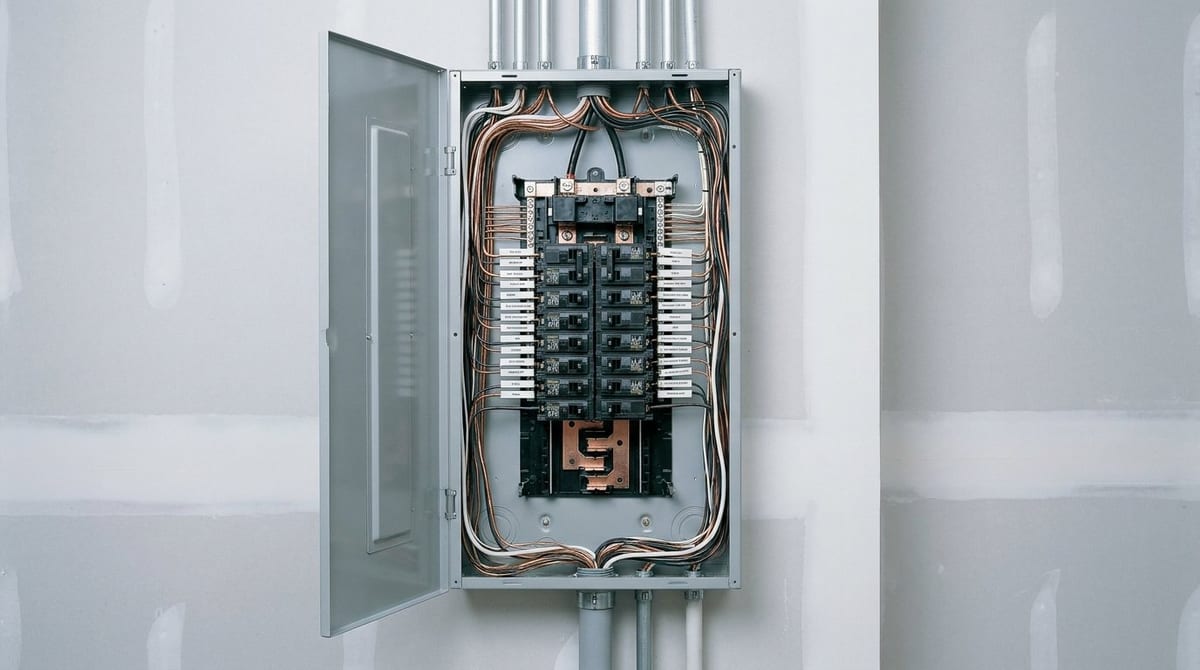
What is an AFCI breaker?
Arc-fault protection that prevents electrical fires — and how it differs from a GFCI.
By The T.A.P. Team · February 2024 · 5 min read
An AFCI (Arc-Fault Circuit Interrupter) is a special breaker that detects the erratic electrical "arcing" caused by damaged, loose, or deteriorated wiring — the kind of fault that starts electrical fires — and shuts the circuit off before it ignites. Modern code requires AFCI protection on most living-area circuits. Where a GFCI protects people from shock, an AFCI protects your home from fire. Here's how they work and where you need them.
- AFCI = arc-fault protection (prevents fires)
- GFCI = ground-fault protection (prevents shock)
- Code requires AFCIs in most living areas (bedrooms, etc.)
- They detect arcing from damaged/loose wiring
- "Nuisance" trips can flag a real wiring problem
What an arc fault is
An arc fault is electricity jumping a gap — at a loose terminal, a nail through a wire, a cracked cord, or a corroded connection. That arc burns hot enough to ignite nearby wood or insulation, and a standard breaker won't catch it because the current can look normal. An AFCI recognizes the erratic electrical signature of arcing and cuts power before a fire starts.
AFCI vs. GFCI
They do different jobs: a GFCI stops shock by catching current leaking to ground; an AFCI stops fire by catching arcing. Modern code requires both in different areas, and "dual-function" (combination) devices provide both in one. If a receptacle or breaker has to do both jobs — say, a kitchen — a combination device is used.
Where code requires them
AFCI protection was first required in bedrooms in the early 2000s and has since expanded to cover most living-area circuits — bedrooms, living rooms, hallways, kitchens, laundry, and more — in newer editions of the electrical code. Older homes usually have none, which is why they're a common addition during a panel upgrade or remodel.
About "nuisance" tripping
AFCIs sometimes trip on certain motor or electronic loads, which frustrates homeowners — but very often the "nuisance" trip is the AFCI correctly catching a real problem: a loose connection, a shared-neutral wiring error, or a failing appliance. The wrong response is to swap the AFCI for a standard breaker; the right one is to have the cause diagnosed. See arcing outlets.
| AFCI | GFCI | |
|---|---|---|
| Protects against | Fire (arc faults) | Shock (ground faults) |
| Detects | Arcing in wiring | Current leaking to ground |
| Required in | Most living areas | Kitchens, baths, garages, outdoors |
| Form | Usually a breaker | Outlet or breaker |
| Both jobs | Combination (dual-function) device | Combination device |
You can DIY
- Reset a tripped AFCI once
- Note what was running when it tripped
- Unplug a suspect appliance and test
- Keep AFCIs in place (don't swap them out)
- Log repeated trips
Call a pro
- Installing AFCI protection
- Diagnosing repeated AFCI trips
- Shared-neutral or wiring corrections
- Combination AFCI/GFCI needs
- Any arcing or burning signs
When an AFCI trips repeatedly, the tempting "fix" is to replace it with a standard breaker so it stops tripping. That removes the exact fire protection that's catching a real fault. Best practice is to treat repeated AFCI trips as a signal, have an electrician find the loose connection, wiring error, or failing device, and keep the arc-fault protection in place. It's protecting the house.
Arc-fault protection in DFW homes
Newer North Texas homes are built with AFCI protection; the many older homes across Plano, Richardson, and Garland usually have none — a worthwhile safety add, often done alongside a panel upgrade. See our electrical team.
The short version
- An AFCI breaker detects arcing from damaged or loose wiring and prevents fires.
- A GFCI prevents shock; an AFCI prevents fire — different jobs, both required by code.
- Code requires AFCI protection on most living-area circuits in newer homes.
- A standard breaker can't catch arcing, which is why AFCIs exist.
- Repeated "nuisance" trips often mean the AFCI is catching a real fault.
- Don't swap an AFCI for a standard breaker — diagnose the cause instead.
AFCI breakers — frequently asked questions

Want arc-fault protection?
Get AFCI protection added by a licensed electrician. Serving Dallas–Fort Worth & North Texas for over 25 years.