
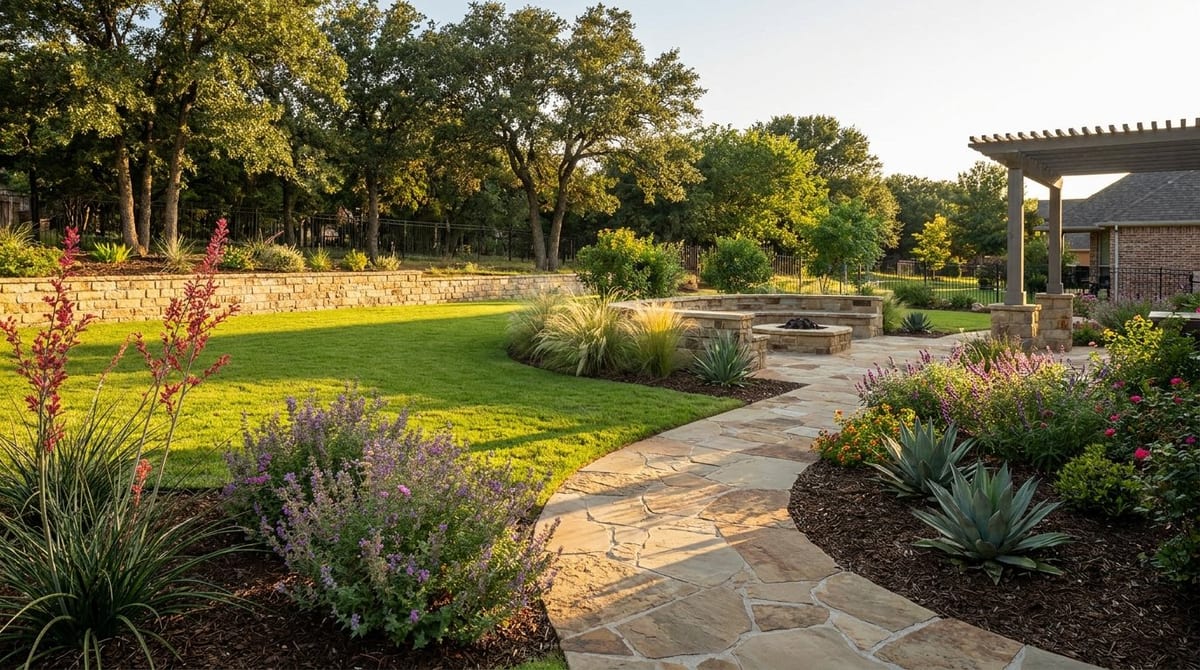
Do I need a sprinkler system?
The convenience-and-consistency case, and how to make it efficient, not wasteful.
By The T.A.P. Team · April 2024 · 5 min read
An in-ground sprinkler (irrigation) system makes watering automatic and consistent — a real advantage for a Texas lawn that needs regular, well-timed water through a long summer. But a system is only as good as its design: efficient zoning, the right heads (spray for turf, drip for beds), and a smart controller determine whether it saves water or wastes it. Here's when a sprinkler system is worth it, and how to make it efficient.
- Automatic, consistent watering — saves time
- Efficiency depends on design + controller
- Spray zones for turf, drip zones for beds
- A smart / weather controller prevents waste
- Texas requires licensed irrigation installers
The case for a system
The main benefits are consistency and convenience: an automatic system waters the whole yard evenly, on schedule, without you dragging hoses — which matters a lot during a long Texas summer when timing and regularity keep a lawn alive. It also protects the investment you've made in turf and plants by never forgetting to water.
Efficiency is in the design
A system can save water or waste it, depending entirely on design. Good design separates zones by plant type and sun exposure, uses drip for beds and matched-precipitation heads for turf, and ensures head-to-head coverage with no dry spots or overspray onto pavement. A poorly designed system can waste more water than hand-watering — see saving landscape water.
Smart controllers and sensors
The controller is where modern systems win. A weather-based (smart) controller adjusts run times to the season and forecast, and a rain or soil-moisture sensor skips watering when it's not needed — big savings, and increasingly required. Pairing efficient hardware with a smart controller is what makes a sprinkler system water-wise.
Rules and installation
In Texas, in-ground irrigation systems must be installed by a licensed irrigator, with proper permitting and a backflow-prevention device to protect the water supply. They also need seasonal maintenance — checking and adjusting heads, and winterizing. It's not a DIY project, but done right it delivers years of efficient, hands-off watering. See our landscaping services.
| Sprinkler system | Hand/hose watering | |
|---|---|---|
| Consistency | Automatic, even | Depends on you |
| Convenience | High | Labor-intensive |
| Efficiency | High (if well-designed) | Variable |
| Cost | Upfront install | Minimal |
| Install | Licensed irrigator | None |
A sprinkler system is worth it when it's designed well — zoned by plant type and sun, drip for beds, matched heads for turf, full coverage — and paired with a weather-smart controller and a rain sensor. That combination waters consistently and efficiently. A cheap, poorly-zoned system on a dumb timer can waste more water than a hose, so the design and controller are where the value is.
Irrigation for North Texas yards
Given our long, hot summers and watering restrictions, a well-designed system with a smart controller is a popular, water-wise choice across Frisco, Plano, and McKinney. We design and install efficient irrigation to code. See our landscaping team.
The short version
- A sprinkler system waters automatically, evenly, and on schedule — great for a Texas summer.
- Its efficiency depends entirely on the design and controller.
- Good design uses drip for beds and matched spray heads for turf, zoned by plant type.
- A weather-smart controller and rain sensor prevent waste and are increasingly required.
- Texas requires a licensed irrigator, a permit, and backflow prevention.
- A poorly designed system can waste more water than a hose — design is everything.
Sprinkler systems — frequently asked questions

Considering a sprinkler system?
Get an efficient system designed and installed to code. Serving Dallas–Fort Worth & North Texas for over 25 years.