
Shared fence rules: who pays and who decides?
Property lines, splitting cost, and keeping the peace on a boundary fence.
By The T.A.P. Team · August 2024 · 6 min read
When a fence sits on the property line between two homes, it's usually a shared (boundary) fence — and that means questions of who pays, who decides on style, and who handles repairs. Whether costs are truly split depends on where the fence sits and any agreements, and the smartest move is almost always a friendly conversation (and a survey) before you build or replace. Here's how shared fences generally work and how to avoid a neighbor dispute.
- On the line = usually a shared fence
- Neighbors often split cost and upkeep
- A survey confirms the true property line
- Talk (and agree in writing) before building
- HOA and city rules still apply
Whose fence is it?
A fence built on the boundary line is generally considered jointly owned by both neighbors, who share responsibility for it. A fence built entirely on one owner's side of the line is that owner's fence. So the first question is location — and the only sure way to know where the line actually runs is a property survey, not the old fence's position (which may be off).
Who pays for a shared fence?
For a true boundary fence, neighbors commonly split the cost of building and maintaining it — but "commonly" isn't "always." There's no universal rule that forces a neighbor to pay half; it often comes down to agreement, local ordinance, or who wants the work done. If you replace a shared fence without discussing it, you may end up paying for all of it.
Decisions, style, and disputes
Because both neighbors have a stake, style, height, and the "good side" facing matter. Many disputes are avoided simply by talking early: agree on cost-splitting, materials, and timing, and put it in writing. If a neighbor won't participate, you can usually still build on your own side at your own cost. Keep it neighborly — you have to live next to each other.
Do it right
Before replacing a boundary fence: get a survey if the line is unclear, talk to your neighbor and agree in writing on cost and design, and check your city and HOA rules. A reputable contractor can build on the line or set it just inside your property as you prefer. This guide is general information — for a real dispute, consult a local attorney.
| Situation | Typical outcome |
|---|---|
| Fence on the property line | Shared; often split cost |
| Fence fully on your side | Yours to decide and pay |
| Neighbor won't split | Build on your side, your cost |
| Line unclear | Get a survey first |
| Style disagreement | Agree early, in writing |
Almost every shared-fence dispute traces back to skipping one of two steps: confirming the property line with a survey, and agreeing with the neighbor before the work starts. Best practice is to do both — know exactly where the line is, agree in writing on cost and design, then build. It's far cheaper than moving a misplaced fence or feuding with the person next door for years.
Neighborly fencing in North Texas
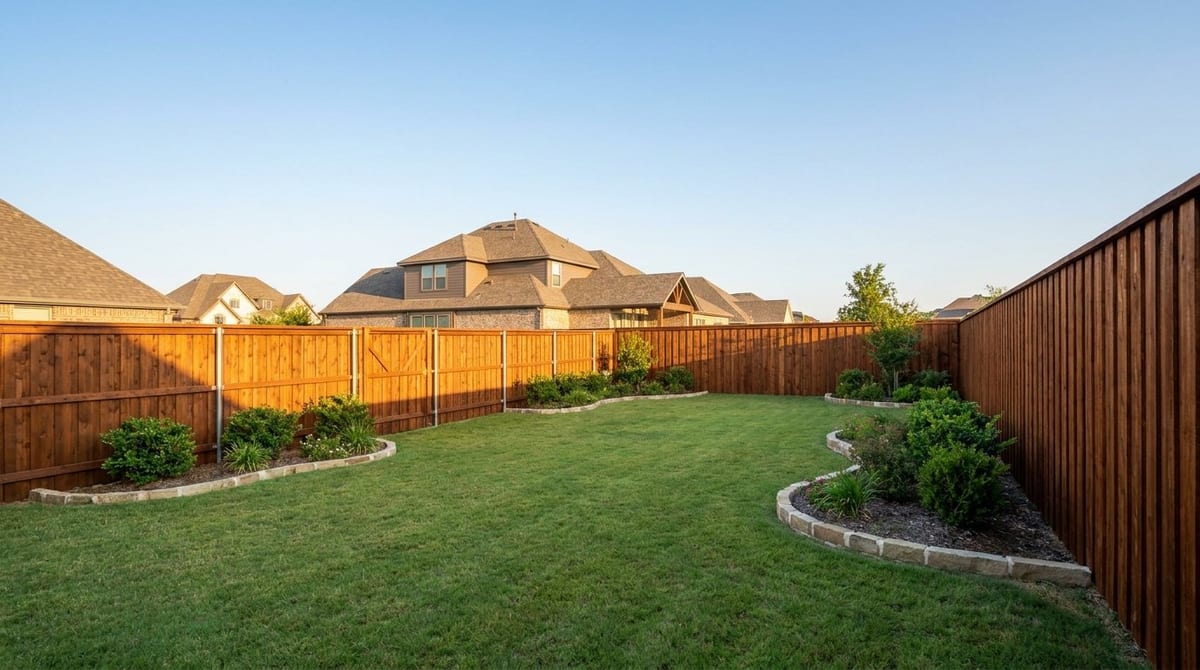
On tight suburban lots across Plano, Frisco, and Allen, most backyard fences are shared boundary fences — so a quick neighbor conversation and a clear line save a lot of grief. We can build on the line or just inside your property, whichever you and your neighbor agree on. See our fence team.
The short version
- A fence on the property line is usually a shared, jointly-owned fence.
- Neighbors often split the cost and upkeep of a boundary fence — but not always.
- A property survey is the only sure way to know where the line runs.
- Talk to your neighbor and agree in writing before building or replacing.
- If a neighbor won't participate, you can usually build on your own side at your cost.
- City and HOA rules still apply — and for real disputes, consult a local attorney.
Shared fence rules — frequently asked questions

Replacing a shared fence?
We build on the line or your side — your call. Serving Dallas–Fort Worth & North Texas for over 25 years.