
How many amps does my house need?
100 vs 200-amp, what a load calculation decides, and what pushes you to 200.
By The T.A.P. Team · June 2024 · 5 min read
Most modern homes need 200-amp electrical service, while smaller homes — or those with gas heat, water heating, and cooking — can sometimes get by on 100 amps. The real answer comes from a load calculation that adds up your home's demand: central AC, electric ranges and dryers, water heaters, and especially EV chargers push many homes past what 100-amp service can safely handle. Here's how to think about it.
- 200-amp: today's standard for most homes
- 100-amp: may suffice for small or all-gas homes
- Central AC + electric appliances push toward 200
- An EV charger often tips it to 200
- A load calculation gives the real answer
What "amps" means here
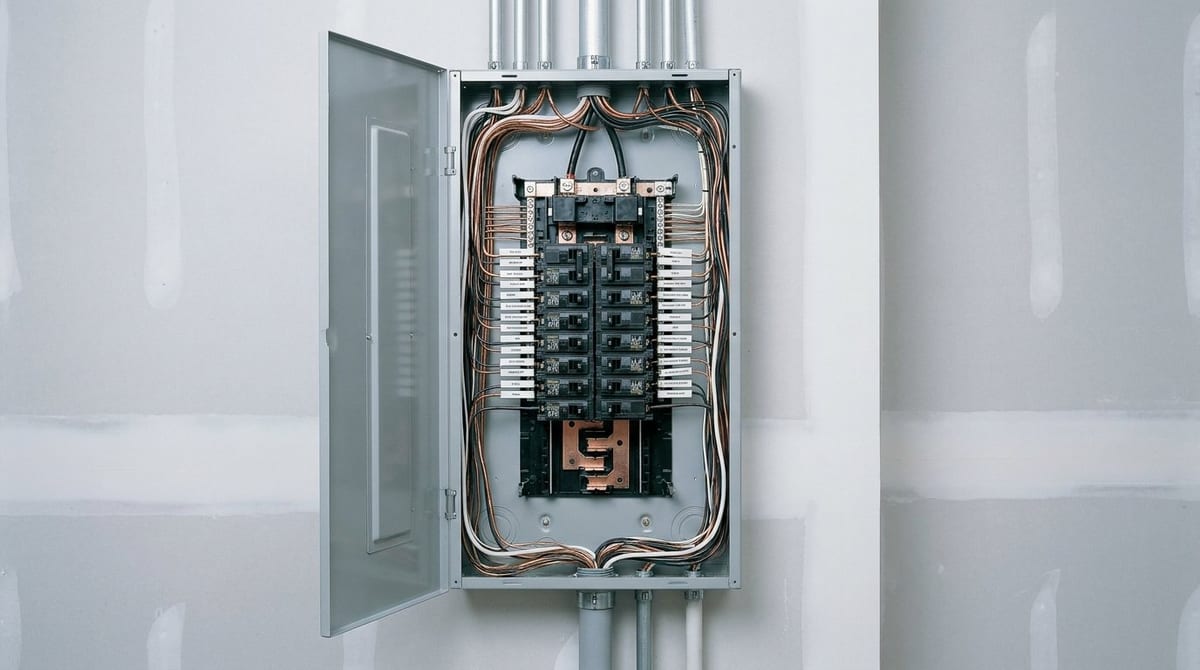
Your service amperage is your home's total electrical capacity — the size of the main breaker and the service coming in from the utility. 100-amp and 200-amp are the two common residential sizes. The question isn't the wiring in one circuit; it's whether the whole home's simultaneous demand fits within the service size.
When 100 amps is enough
A smaller home with gas heat, a gas water heater, and a gas range may run fine on 100-amp service — there simply isn't much electrical load. The catch is headroom: 100-amp service leaves little room to add central AC, an electric appliance, or an EV charger later without maxing out.
What pushes you to 200
Electric-heavy homes need the capacity: central AC, an electric range, dryer, and water heater, plus a hot tub, workshop, or — the big one lately — an EV charger, quickly exceed 100 amps. Additions and future plans push the same way. 200-amp service is the modern default because it comfortably handles all of it.
The load calculation
Rather than guess, an electrician runs a load calculation — a code-based tally of your home's demand — to size the service correctly. It's the same idea as sizing an AC by a load calc: measure the actual need. If the calc shows you're near or over your 100-amp capacity, a panel and service upgrade to 200 amps is the fix.
| 100-amp | 200-amp | |
|---|---|---|
| Best for | Small / all-gas homes | Most modern homes |
| Central AC + electric appliances | Tight | Comfortable |
| EV charger | Often too much | Handles it |
| Future headroom | Little | Plenty |
| Right size | By load calculation | By load calculation |
Don't size your service by rule of thumb or by what's already there — have an electrician run a load calculation on your actual demand, and factor in what you'll add (an EV, a pool, an addition) over the next several years. Upsizing to 200 amps once, with headroom, beats maxing out a 100-amp panel and paying to upgrade again a year later.
Service size in North Texas homes
Many older DFW homes still run 100-amp service that today's central AC and growing EV adoption strain, so 200-amp upgrades are common across Frisco, McKinney, and Allen. We run the load calc and upgrade the service. See our electrical team.
The short version
- Most modern homes need 200-amp service; small or all-gas homes may be fine on 100.
- Central AC plus electric appliances push a home toward 200-amp.
- An EV charger often tips a home from 100 to 200 amps.
- 100-amp service leaves little headroom for future additions.
- A load calculation gives the accurate answer, not a rule of thumb.
- If you're near your 100-amp capacity, a 200-amp upgrade is the fix.
Home amperage — frequently asked questions
Not sure if 100 amps is enough?
Get a load calculation and honest advice. Serving Dallas–Fort Worth & North Texas for over 25 years.